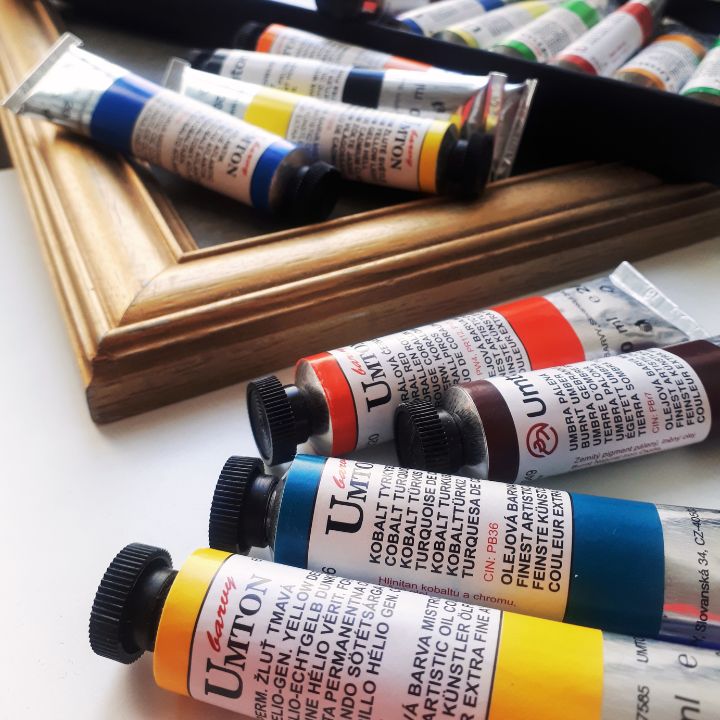
1.Erdfarben: Die ältesten Pigmente der Welt
Die älteste „Palette“ war der Boden selbst. Prähistorische Künstler gruben eisenreiche Erde aus, um Ockern und Umbras herzustellen, gemischt mit Fett, Wasser oder Baumsaf.
- Ockern (Gelb, Rot, Braun)
Eisenoxide im Boden erzeugen warme Gelbtöne und Rottöne, die Sie noch als Gelber Ocker, Roter Ocker und ähnliche Erdtöne kennen. Das Erhitzen dieser Erden in einem Ofen vertieft die Farbe und verwandelt rohen Sienna in gebrannten Sienna sowie rohen Umber in gebrannten Umber.
Auf Ihrer Palette: Suchen Sie nach Erdfarben wie „Gelber Ocker“, „Roher Umber“, „Gebrannter Umber“ und „Gebrannter Sienna“ in Ihrem Sortiment für Öl-, Gouache- oder Aquarellfarben.
→ Ölfarbe – Gebrannter Sienna
→ Aquarell – Gelber Ocker
- Benannt nach Orten
Viele Erdpigmente tragen noch heute geographische Namen: Umber (Umbrien), Sienna (Siena), Verona-Grün, Terre Verte (Grüne Erde). Diese wurden einst wörtlich aus diesen Regionen ausgegraben.- Auf Ihrer Palette: „Böhmische Grüne Erde“ ist fantastisch für Unterlassierungen von Haut oder subtile Landschaftsgrüntöne.
- → Ölfarbe – Böhmische Grüne Erde
Diese Farben sind stabil, lichtecht und sanfte Mixtoner – perfekte Basistöne für Landschaften, Porträts und Unterlassierungen.

2.Steine und Minerale: Als Farbe mehr wert war als Gold
Mit wachsendem Reichtum der Zivilisationen blickten Künstler über den Boden hinaus zu blendenden Mineralen und Halbedelsteinen.
Ultramarin: Lapis Lazuli „jenseits des Meeres“
Ultramarin wurde ursprünglich durch Mahlen von Lapis Lazuli hergestellt, das in Afghanistan abgebaut und über Venedig nach Europa importiert wurde. Es war so teuer, dass Auftraggeber in Verträgen manchmal genau festlegten, wie viel verwendet werden durfte – meist für die Gewänder der Jungfrau Maria reserviert.
- Historische Fakten:
- Name aus dem Lateinischen ultramarinus – „jenseits des Meeres“.
- Über Jahrhunderte war es wörtlich teurer als Gold.
- Eine synthetische Version wurde erst 1828 erfunden und damit für alle Künstler erschwinglich.
- Auf Ihrer Palette heute:
- „Ultramarinblau“ ist immer noch eine Kernfarbe in jeder ernsthaften Palette – intensiv, leicht rötlich und perfekt für Himmel, Schatten und Lasuren.
→ Empfehlung: Ultramarinblau Ölfarbe
→ Empfehlung: Ultramarinblau Aquarell
- „Ultramarinblau“ ist immer noch eine Kernfarbe in jeder ernsthaften Palette – intensiv, leicht rötlich und perfekt für Himmel, Schatten und Lasuren.
Malachit und Grünspan: Antike Grüntöne
Malachit, ein grünes Kupferkarbonat, wurde gemahlen, um eines der frühesten Grünpigmente zu erzeugen, besonders in ägyptischer Kunst und mittelalterlichen Manuskripten. Grünspan, ein künstlich hergestelltes Grün aus Kupfer, das Zudampf von Essig ausgesetzt wurde, war einst das hellste verfügbare Grün, neigte aber dazu, mit der Zeit zu verdunkeln.
- Auf Ihrer Palette heute:
- Moderne „Olivengrün“, „Viridian“ und verschiedene „Phthalo-Grüntöne“ sind die sicheren, stabilen Erben dieser historischen Grüntöne.
→ Gouachen – Permanentes Grün
→ Öl – Viridian
- Moderne „Olivengrün“, „Viridian“ und verschiedene „Phthalo-Grüntöne“ sind die sicheren, stabilen Erben dieser historischen Grüntöne.
Diese Mineral- und Kupfergrüntöne gaben Künstlern neue Möglichkeiten, Laub, Stoffe und leuchtende Drapierungen zu malen – und Sie bauen noch heute auf dieser Tradition auf.

3.Farben aus Lebewesen: Pflanzen, Bäume und Insekten
Vor der synthetischen Chemie stammten viele lebendige Farben aus Pflanzen und Insekten. Diese waren meist Färbemittel statt echter Pigmente und oft auf einem Substrat („See-Pigment“) gebunden für die Verwendung in Farbe.
Rottöne: Färberwurzel, Brasilholz, Kermes und Cochenille
- Färberwurzel (Rubia tinctorum) lieferte tiefe Rottöne und Pinktöne, bekannt als Rose Madder oder Türkischrot, verwendet für Textilien und Malerei.
- Brasilholz gab helle Rot- und Purpurtöne durch Oxidation seines Farbstoffs.
- Kermes (mediterrane Schildläuse) und später Cochenille (Insekten aus Mittel- und Südamerika) produzierten intensive Scharlach- und Karmesintöne, genutzt in Luxusstoffen und Künstlerseen.
- Mit der Industriellen Revolution wurden diese organischen Rottöne durch synthetische Pigmente ersetzt, wie Alizarin (das Färbeprinzip der Färberwurzel, erstmals 1869 synthetisiert) und später moderne Rottöne wie Quinacridone und Cadmiums.
- Auf Ihrer Palette heute:
- Wenn Sie „Chinesisches Zinnober“, „Korallenrot“ oder „Madder Deep Lake“ verwenden, nutzen Sie oft Nachkommen von Färberwurzel und Cochenille, die lichtechter und zuverlässiger gestaltet sind.
- → Öl – Madder Deep Lake
- → Öl – Korallenrot
Exotische Gelb- und Orangetöne
- Indianisches Gelb wurde angeblich aus dem Urin von Kühen hergestellt, die Mangoblätter gefressen hatten, und ergab ein leuchtendes, transparentes Gelb.
- Orpiment, ein brillantes Arsensulfid, und Realgar, sein oranger Verwandter, lieferten helle, aber hochgiftige Gelb- und Orangetöne.
- Pflanzliche Farben wie Waid, Kurkuma und Safran ergänzten Gelb- und Gelb-Orange-Töne für Textilien und manchmal Kunstwerke.
- Auf Ihrer Palette heute:
- Moderne „Naples Yellow Deep“, „Helio Gen. Yellow Middle“ und „Brilliant Yellow Deep“ sind so gestaltet, dass sie ähnliche Leuchtkraft bieten, ohne giftige oder grausame Ursprünge.
→ Gouache – Nickelgelb
→ Aquarell – Cadmiumgelb Hellstes
- Moderne „Naples Yellow Deep“, „Helio Gen. Yellow Middle“ und „Brilliant Yellow Deep“ sind so gestaltet, dass sie ähnliche Leuchtkraft bieten, ohne giftige oder grausame Ursprünge.

4.Purpur-Revolutionen: Von Schalentieren zur Chemie
Wahres Purpur war einst seltener als jedes Juwel.
- Tyrierisches Purpur stammte aus mediterranen Murex-Schnecken. Zehntausende Schnecken ergaben nur eine kleine Menge Farbstoff, was Purpur teurer als Gold machte und es rechtlich Kaisern und hohem Klerus vorbehielt.
- 1856 schuf William Henry Perkin versehentlich den ersten Anilinfarbstoff – „Mauve“ – beim Versuch, Chinin zu synthetisieren. Dieses synthetische Purpur löste einen Modewahnsinn aus und begründete die moderne Farbstoffindustrie.
- Bald folgten andere synthetische Farben wie Fuchsin (Magenta) und Kobaltviolett.
- Auf Ihrer Palette heute:
- „Manganviolett“ und „Cobalt Violet Hue“ sind direkte Nachkommen dieser farbrevolution des 19. Jahrhunderts.
→ Öl – Cobalt Violett Hell
→ Aquarell – Cobalt Violett Tief
- „Manganviolett“ und „Cobalt Violet Hue“ sind direkte Nachkommen dieser farbrevolution des 19. Jahrhunderts.

5.Das Zeitalter synthetischer Blautöne und Grüntöne
Nach Indigo, Lapis und Ägyptischblau brachten das 18.–19. Jahrhundert eine Welle neuer synthetischer Blautöne.
- Indigo (aus Indigofera tinctoria) war ein geschätzter natürlicher Blutfarbstoff, der aus Indien nach Europa exportiert wurde und Waid verdrängte.
- Ägyptischblau, erstmals im alten Ägypten durch Erhitzen von Kupferverbindungen mit Sand und Kalk entwickelt, gilt als erstes synthetisches Pigment der Geschichte, dessen Rezept später verloren ging und wiederentdeckt wurde.
- Preußischblau (Berlin, 1704) war das erste moderne synthetische anorganische Pigment mit vollständig dokumentierter Geschichte – tief, erschwinglich und sehr einflussreich.
- Kobaltblau, lange in der Keramik bekannt, wurde im frühen 19. Jahrhundert als Künstlerpigment formuliert und wurde zu einem Favoriten von Malern wie Monet und Renoir.
- Französisches Ultramarin und Ceruleanblau erweiterten die Vielfalt an Himmel- und Meeresnuancen.
- Auf Ihrer Palette heute:
- „Preußischblau“, „Kobaltblau“, „Ceruleanblau“ und „Ultramarin Tiefblau“ sind Grundnahrungsmittel für Landschaften, Seestücke und expressive Farbarbeit.
→ Öl – Preußischblau
→ Aquarell – Kobaltblau Atlantic
→ Gouache – Ceruleanblau
- „Preußischblau“, „Kobaltblau“, „Ceruleanblau“ und „Ultramarin Tiefblau“ sind Grundnahrungsmittel für Landschaften, Seestücke und expressive Farbarbeit.
Für Grüntöne boten spätere synthetische Pigmente wie Viridian und chrombasierte Grüntöne leistungsstarke Alternativen zu älteren, instabilen Arsengrüntönen wie Scheeles Grün und Smaragdgrün.

6. Cadmiums, Chromes und die moderne helle Palette
Mit dem Aufstieg der Industriechemie erhielten Künstler Zugang zu helleren, reineren und kraftvolleren Pigmenten.
- Cadmiumpigmente (Gelb, Orange, Rot) werden aus Cadmiumverbindungen hergestellt und bieten außergewöhnliche Deckkraft, Sättigung und Lichtechtheit.
- Chrome-Gelbtöne, Smaragdgrün und andere neue Pigmente halfen Impressionisten und Fauvisten, die Farbintensität auf neue Stufen zu heben.
- Viele historische Pigmente (wie Zinnober oder giftige Chrome-Farben) wurden seither durch sicherere Alternativen ersetzt oder imitiert, während Cadmiums selbst nun streng reguliert sind und oft neben „cadmiumfreien“ Nuancen angeboten werden.
- Auf Ihrer Palette heute:
- Verwenden Sie „Cadmiumgelb“, „Cadmiumrot“ und ihre modernen Nuancen, wenn Sie starke, deckende Primär- und Sekundärfarben brauchen.
- → Öl – Cadmiumgelb Hell
→ Aquarell – Cadmiumrot Mittel

7. Weiß, Schwarz und die unsichtbaren Helden Ihrer Palette
Nicht jedes Pigment ist auffällig, aber Weiß- und Schwarztöne sind essenziell für jedes Gemälde.
Weißtöne
- Bleiweiß dominierte jahrhundertelang die europäische Malerei, ist aber hochgiftig.
- Zinkweiß war weniger toxisch, aber spröde in Öl.
- Titandioxidweiß, im frühen 20. Jahrhundert als Pigment entwickelt, verbindet hohe Deckkraft, starke Tönkraft und Untoxizität – es ist der Standardweiß in den meisten modernen Farben geworden.
- Auf Ihrer Palette heute:
- Verwenden Sie „Titandioxidweiß“ als Ihren Hauptmisch- und Deckkraft-Weiß; erwägen Sie „Zinkweiß“ oder „Deckkraftweiß“, wenn Sie sanftere Töne und Lasuren brauchen.
→ Öl – Titandioxidweiß
→ Gouache – Zinkweiß
- Verwenden Sie „Titandioxidweiß“ als Ihren Hauptmisch- und Deckkraft-Weiß; erwägen Sie „Zinkweiß“ oder „Deckkraftweiß“, wenn Sie sanftere Töne und Lasuren brauchen.
Schwärzen
- Die frühesten Schwärzen waren Holzkohle aus verbranntem Holz und Knochen Schwarz aus verkohltem Knochen.
- Verschiedene Schwärzen haben unterschiedliche Temperaturen: Knochen-Schwarz ist oft leicht warm; pflanzliche Schwärzen (wie Rebschwarz) wirken kühler.
- Künstler mischen Schwarz oft mit anderen Farben, um tiefe, subtile Schatten oder reiche Neutrale zu erzeugen.
- Auf Ihrer Palette heute:
- Vergleichen Sie „Elfenbeinschwarz“, „Eisenschwarz“ und „Payne’s Grey“, um zu sehen, wie jede Ihren Schatten und Mischungen verändert.
→ Öl – Elfenbeinschwarz
→ Aquarell – Payne’s Grey Tief
- Vergleichen Sie „Elfenbeinschwarz“, „Eisenschwarz“ und „Payne’s Grey“, um zu sehen, wie jede Ihren Schatten und Mischungen verändert.

8. Vom Pigment zur Farbe: Bindemittel, Grundierungen und Firnis
Alle Pigmente brauchen einen Binder, um Farbe zu werden, und eine geeignete Oberfläche, um zu strahlen.
- Ölfarbe: Pigment gemischt mit Ölen wie Leinöl, Walnussöl oder Mohnöl, berühmt ab dem 15. Jahrhundert. Langsames Trocknen erlaubt Übergänge, Lasuren und subtile Verläufe – ideal für detaillierte Arbeiten und reiche Texturen.
→ Professionelles Mal- Ölfarben-Set Walsh 20 mit 36 hochwertigen 20-ml-Tuben, Leinöl 100 ml, Terpentinöl 100 ml und einem Flachpinsel - Aquarell und Gouache: Pigment mit wasserlöslichem Binder (meist Gummi Arabicum). Aquarell ist transparent; Gouache deckend, ideal für Design, Illustration und Grafikarbeiten.
→ Künstler-Aquarell – Sets mit 24 oder 36 Farben
→ Gouache-Set oder Einzel farben - Gesso: Eine weiße Grundierung aus Kreide oder Gips, verwendet zum Grundieren von Leinwand oder Holztafeln. Traditionell in mehreren Schichten aufgetragen (grobporiges Gesso Grosso, dann feines Gesso Sottile), geschliffen für glatte Mal- und Vergoldungsoberflächen.
- Firnis: Eine klare Abschluss-Schicht, die den Glanz vereinheitlicht und das Gemälde schützt. Historisch aus Baumharzen und Ölen, moderne Firnisse enthalten synthetische Harze, die weniger gelben und sicherer entfernbar sind.
→ Damarfirnis oder Waxfirnis
9. So erkunden Sie diese Geschichte in Ihrer eigenen Arbeit
Wenn Sie „mit Geschichte malen“ möchten, hier ein paar einfache Projektideen, die direkt mit Produktvorschlägen verknüpft sind:
- „Alte Meister“-Palette
- Erdfarben: Gelber Ocker, Roher Umber, Gebrannter Umber, Gebrannter Sienna.
- Ein starkes Blau: Ultramarin Tiefblau oder Kobaltblau.
- Ein historisches Rot: Cadmiumrot Tief oder ein Madder-Typ-Rot.
- Weiß: Deckkraftweiß (mit Mischweiß für weichere Töne, falls gewünscht).
→ Entdecken Sie das Bundle: Old Masters Oil Palette Set
- „Impressionisten“-helle Palette
- Cadmiumgelb, Cadmiumrot (oder Cadmium-Nuance), Kobaltblau, Ultramarin, Viridian oder Eisenschwarz, plus Deckkraftweiß.
→ Erstellen Sie ein Bundle: Impressionisten-Gouachen-Set
- Cadmiumgelb, Cadmiumrot (oder Cadmium-Nuance), Kobaltblau, Ultramarin, Viridian oder Eisenschwarz, plus Deckkraftweiß.
- „Mineral & Erde“-Aquarell-Palette
- Gelber Ocker, Naples Yellow, Rohes Sienna, Gebrannter Sienna, Cobalt Violett, Fleischfarbe, Van-Dyck-Braun, Ultramarinblau, Payne’s Grey, Cobalt Türkis, Azurblau, Indigo, Elfenbeinschwarz, Deckkraftweiß
→ Aquarelle Metall 30x2,6ml
- Gelber Ocker, Naples Yellow, Rohes Sienna, Gebrannter Sienna, Cobalt Violett, Fleischfarbe, Van-Dyck-Braun, Ultramarinblau, Payne’s Grey, Cobalt Türkis, Azurblau, Indigo, Elfenbeinschwarz, Deckkraftweiß
